

Custom Web Services: The Smart Way to Scale Your Business...
Read MoreQA Methodologies: Types, Advantages and Challenges Avatar photo Test scenario Testing Team
QA methodologies
QA methodologies are systematic approaches used to ensure that the software development process is carried out in a way that guarantees the highest level of quality for the end product.
In this article, we will explore various QA methodologies, their importance, and how they can be implemented effectively.
Waterfall Methodology
- Waterfall methodology is a project management approach that uses a sequential process to develop a project:
- What it is: A linear process where each phase is completed before moving on to the next. The term “waterfall” refers to how each task cascades into the next step.
- How it works: The process involves detailed planning, execution, testing, and maintenance.
- When it’s used: It’s often used in software engineering and product development.
- Benefits: It can help with planning, efficiency, quality control, and aligning with fixed budgets and timelines.
- Drawbacks: It can be difficult to gather all the requirements upfront, and it doesn’t allow for flexibility during the project. Testing is delayed until the final stage, which can lead to rework if issues are found.
History: The term was coined by Dr. Winston W. Royce in 1970 in a research paper on software development.
Visualizations: It’s often depicted as a flow chart or Gantt chart.
The seven stages of the waterfall model are:
- Requirements
- Analysis
- Design
- Coding and implementation
Testing - Operation and deployment
Agile Methodology
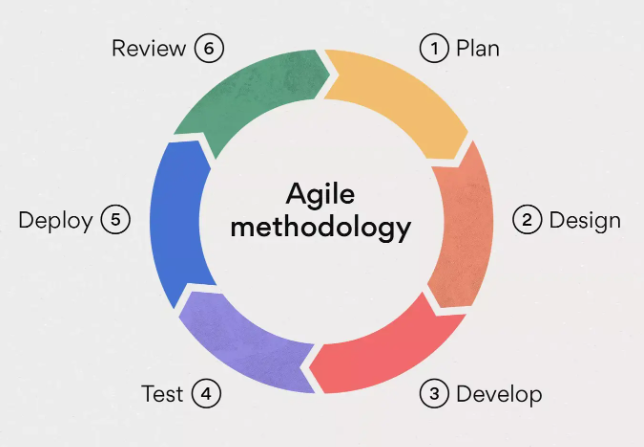
Agile methodology is a project management framework that focuses on collaboration, adaptability, and delivering value quickly. It’s an iterative process that breaks projects into phases, or sprints, and involves regular reflection and adjustment.
Some key principles of Agile methodology include:
Prioritizing individuals and interactions: Agile teams are self-organizing and cross-functional, bringing together people with different skills to work together.
Embracing change: Agile teams are responsive to change and can pivot based on feedback.
Delivering value incrementally: Agile teams deliver working software in short-term development cycles.
Continuous feedback: Agile teams receive regular feedback, which allows them to adjust to challenges and stakeholders to communicate consistently. Some popular Agile methodologies include:
- Scrum: Uses short development cycles, called sprints, to produce a shippable product increment. Sprints are usually between 1 and 4 weeks long.
- Kanban: Focuses on visualizing the workflow and prioritizing work in progress.
- Extreme Programming (XP): Emphasizes speed and continuous delivery. XP is often recommended for small teams of experienced developers.
- Feature-Driven Development (FDD): Uses short phases of work to deliver working software in a timely manner.
- Agile methodology was originally created for software development, but it’s now used in many different types of projects and organizations.
V-Model (Verification and Validation Model)
The V-model is a type of SDLC model where the process executes sequentially in a V-shape. It is also known as the Verification and Validation model. It is based on the association of a testing phase for each corresponding development stage. The development of each step is directly associated with the testing phase
Spiral Methodology
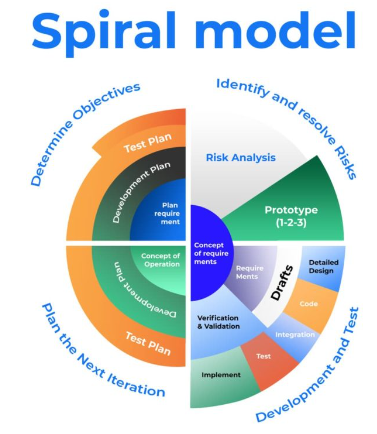
The Spiral methodology is a risk-driven approach coupled with the elements of Waterfall and iterative development methods. Much emphasis is placed on risk assessment and mitigation through the use of multiple iterations, or spirals. Each of which is composed of planning, risk analysis, engineering, and evaluation.
Advantages of Spiral Methodology:
- Effective at managing risk and uncertainty within large, complicated projects.
- Flexibility in accepting changes and new requirements.
- Allows for incremental releases of the product.
- Challenges:
- Can be complex to handle, requiring specific knowledge.
- Higher costs and investment in time because of the detailed planning and risk analysis.
- Not suitable for smaller projects due to its relatively low budget.
Scrum Framework
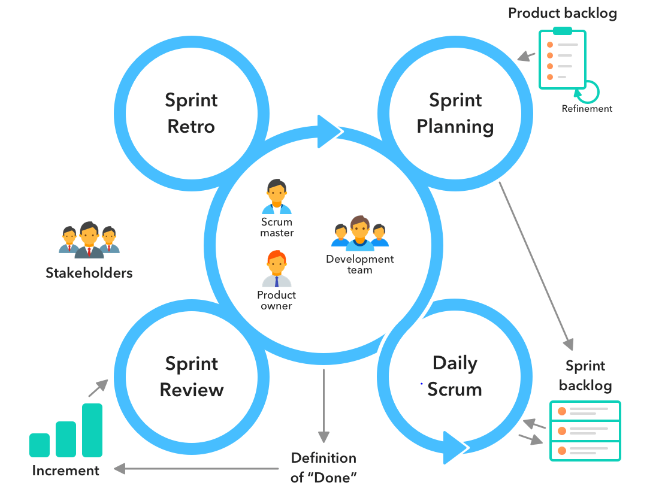
Scrum is an Agile framework for team collaboration that emphasizes teamwork, accountability, and iterative progress toward a well-defined goal. The Scrum way separates the project into small pieces of work on the product being developed, called iterations and sprints. Typically, each sprint spans between one to four weeks, ending in a potentially shippable increment of the product in its new state.
Advantages of Scrum:
High level of collaboration and communication among team members.
Frequent delivery of product increments, with early feedback.
Ability of flexibility when project requirements change.
Challenges:
Requires disciplined team members who are committed to the process.
If the sprint goals are not clearly defined, scope creep may occur.
A strong and experienced Scrum Master is required to guide the team.
Kanban Methodology
Another Agile methodology is Kanban; focused on visualization of workflows, managing the flow of tasks, and limiting work in progression. Kanban is never time-boxed unlike Scrum; hence, teams using this approach can deliver software continuously once it is ready.
Advantages of Kanban:
Provides a visual of the workflow, hence easy to track what is going on with it.
Freedom of managing work items in the absence of fixed iterations that impose their own restrictions.
Continuous delivery and improvement of the product.
Challenges:
Requires discipline to manage work in progress limits.
Less structure compared to other Agile methodologies, which could lead to a number of inconsistencies.
May not be suitable for teams or projects that require more formalized processes.
Continuous Integration and Continuous Deployment (CI/CD)
CI/CD refers to a set of practices aimed at making developers integrate code changes frequently into a single central repository (Continuous Integration) and automatically deploy those changes to production (Continuous Deployment). This approach allows for speedy, reliable releases of software.
Advantages of CI/CD:
- Does reduce time and manpower in integrating code into deployment.
- Therefore, early detection of a defect provides for quicker resolution of the same.
- Allows teams to deliver updates and new features in a fast manner.
Challenges:
- It requires a robust infrastructure and automated testing to be effective.
- Initial setup can be complex and time-consuming.
- Continuous deployment can lead to issues if not carefully managed.
- CI/CD refers to a set of practices aimed at making developers integrate code changes frequently into a single central repository (Continuous Integration) and automatically deploy those changes to production (Continuous Deployment). This approach allows for speedy, reliable releases of software.
Behaviour-Driven Development (BDD)
Behaviour-Driven Development (BDD) is an Agile methodology that encourages developers, testers, and business stakeholders to collaborate. The focus of BDD is to define the behaviour of the system through examples in plain language, that are used as the basis for test cases.
Advantages of BDD:
- Promotes collaboration and shared understanding among all stakeholders.
- Improves communication, bridges gaps between business and technical teams.
- This provides a clear, executable specification that guides the development process.
Challenges:
- It requires all team players’ buy-in if it is to work effectively.
- May be challenging to execute in teams who do not continue with this level of collaboration.
- Needs consistent effort to maintain clear and concise examples.
Effective software testing doesn’t just help deliver a product; it helps deliver an experience that users can trust.
Test-Driven Development (TDD)
Advantages of TDD:
- Ensures that the codebase is well tested from the very beginning.
- This, in turn, leads to better design decisions and cleaner code.
- This facilitates faster debugging and better maintenance of code.
Challenges:
- Can be time-consuming, with a disciplined approach.
- May slow down initial development, but pays off in the long run.
- It may not be suitable for projects with fast-changing requirements.
Hybrid Methodologies
In many cases, a single QA methodology may not be sufficient to meet the needs of a complex project. Hybrid methodologies permit the combination of different QA approaches in a manner that best delivers an appropriate strategy for the given project.
Advantages of Hybrid Methodologies:
It allows flexibility in choosing the best practices from other methods.
Can be tailored to meet the specific needs and challenges of a project.
Allows teams to be more adaptive and responsive to changing requirements.
Challenges:
Particularly hard to handle and coordinate within a big team.
Requires a deep understanding of multiple methodologies to implement effectively.
Therefore, there is a potential for confusion or conflict if it is not clearly defined and communicated.
Conclusion: Choosing the Right QA Methodology for Your Project
Selecting the right methodology of QA is crucial for the success of your software project. Every methodology has its strengths and battles, and the question of the best involves factors like project size, complexity, budget, timeline, and team structure.Whether you choose to go with a traditional method like Waterfall, a flexible Agile framework, or any hybrid methodology, the trick to everything is ensuring your QA strategy aligns with your project goals and business objectives.
At Test scenario, we are dedicated to being your guide through the intricacies of software quality assurance.
Our team of experts is well versed in various QA methodologies, and we work closely with you to devise a suitable QA strategy that addresses your needs in the best possible way.
Contact us to know more about our full-scale QA services.
Categories
Recent Articles

Custom Web Services: The Smart
Custom Web Services: The Smart Way to Scale Your Business...
Read More
The API Revolution: Driving the
The API Revolution Driving the Future of Web Services In...
Read More
🌐 Web Services: Fueling Digital
🌐 Web Services: Fueling Digital Innovation for Modern Businesses In...
Read More